

Automotive E-Commerce Market Growth to USD 477.56 Billion by 2035 at 18.4% CAGR
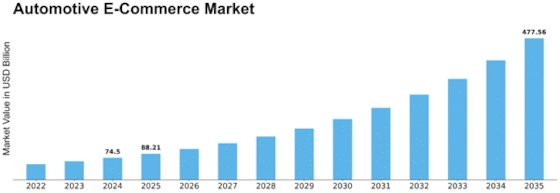
Automotive E-Commerce Market Size
Automotive E-Commerce Market is projected to grow from USD 88.21 bn in 2025 to USD 477.56 bn by 2035, register a robust CAGR of 18.4% during the forecast period
NEW YORK, NY, UNITED STATES, December 9, 2025 /EINPresswire.com/ -- According to Market Research Future (MRFR) analysis, the Automotive E-Commerce Market was valued at USD 74.5 billion in 2024. The industry is poised for significant expansion, with valuations projected to rise from USD 88.21 billion in 2025 to approximately USD 477.56 billion by 2035. This trajectory represents a robust Compound Annual Growth Rate (CAGR) of 18.4% over the forecast period.The Automotive E-Commerce Market refers to the digital platforms and channels used for the buying, selling, and distribution of automotive vehicles, aftermarket parts, components, and accessories. This sector has transitioned from a niche alternative to a fundamental component of the global automotive ecosystem. Its importance lies in its ability to bridge the gap between manufacturers, distributors, and end-consumers, offering unparalleled convenience, transparency, and efficiency.
Get Free Sample Report for Detailed Market Insights: https://www.marketresearchfuture.com/sample_request/4682
Market Overview
Historically, the automotive industry relied heavily on physical interactions. Consumers visited dealerships to purchase vehicles and relied on local garages or specialized retailers for spare parts. The supply chain was linear and often opaque, with limited options for price comparison or product verification. The advent of the internet initially introduced basic listing sites, but the market has since evolved into a sophisticated digital ecosystem.
The current scenario is characterized by a "phygital" approach—a blend of physical and digital experiences. Advancements in logistics and secure payment gateways have emboldened consumers to purchase high-value items, including entire vehicles, online. Furthermore, the global disruption of supply chains in recent years accelerated digital adoption, forcing Original Equipment Manufacturers (OEMs) and aftermarket players to establish direct-to-consumer (DTC) channels. Today, the market encompasses a vast array of services, from B2B procurement for workshops to B2C platforms catering to the "Do-It-Yourself" (DIY) enthusiast, all supported by advanced data analytics and inventory management systems.
Market Dynamics
The automotive e-commerce sector is influenced by a complex interplay of various factors that determine its trajectory.
Drivers The primary driver is the rapid digitalization of retail. Consumers accustomed to the convenience of general e-commerce now expect the same seamless experience when purchasing vehicle components. The rising average age of the global vehicle fleet also drives demand for aftermarket parts, as older vehicles require more frequent maintenance. Additionally, the "Do-It-Yourself" (DIY) culture has gained significant traction, fueled by online tutorials and forums that empower car owners to perform their own repairs, thereby boosting online parts sales.
Restraints Despite growth, the market faces hurdles. A major restraint is the prevalence of counterfeit parts, which poses safety risks and erodes brand trust. Logistics for heavy and bulky automotive components—such as engines or transmission systems—remain expensive and complex compared to standard consumer goods. Furthermore, the technical nature of auto parts can lead to high return rates if customers incorrectly identify the components compatible with their specific vehicle models.
Opportunities The shift toward electric vehicles (EVs) presents a massive opportunity for e-commerce platforms to specialize in EV-specific components and charging accessories. There is also growing potential in cross-border e-commerce, allowing consumers to source hard-to-find parts from international markets. The integration of "Do-It-For-Me" (DIFM) services, where a part is bought online and shipped directly to a professional installer, is another expanding avenue.
Challenges Maintaining accurate, up-to-date catalog data is a persistent challenge. Ensuring that thousands of SKUs are correctly matched to the constantly changing year, make, and model of vehicles requires immense data management. Additionally, traditional dealerships often view direct-to-consumer e-commerce as a threat, creating channel conflict that manufacturers must navigate carefully.
To explore more market insights, visit us at: https://www.marketresearchfuture.com/reports/automotive-ecommerce-market-4682
Market Segmentation
The Automotive E-Commerce market is segmented to address the diverse needs of the industry.
By Type: The market is broadly categorized into Infotainment and Multimedia, Engine Components, Tires and Wheels, Interior Accessories, and Electrical Products. Infotainment systems and interior accessories are popular online purchases due to their lower technical complexity and ease of installation. Conversely, engine components often require more technical verification before purchase.
By Application: Segmentation includes Interior, Exterior, and Performance. Exterior applications, such as lighting, bumpers, and side mirrors, see high volume due to collision repairs and aesthetic upgrades. Performance parts cater to a specific enthusiast niche looking to enhance vehicle power and handling.
By End-User: The market serves two distinct groups: B2C (Business-to-Consumer) and B2B (Business-to-Business). The B2C segment is driven by individual car owners and DIY enthusiasts. The B2B segment, which is substantial, involves garages, workshops, and fleet owners procurement of bulk parts to ensure operational efficiency.
By Region: Geographically, the market is divided into North America, Europe, Asia-Pacific, Latin America, and the Middle East & Africa. Each region exhibits unique characteristics based on vehicle ownership rates and digital infrastructure.
Regional Insights
North America remains a mature and highly developed market for automotive e-commerce. The region is characterized by a strong DIY culture and an established logistics infrastructure that supports rapid delivery. Major retail chains here have successfully transitioned to omnichannel models, blending physical store networks with powerful online platforms.
Europe is a significant market driven by high automotive manufacturing standards and strict regulatory environments. There is a growing trend in Europe towards sustainability, with increasing online demand for remanufactured and eco-friendly auto parts. The presence of premium automotive brands also drives a robust market for high-quality OEM parts.
Asia-Pacific represents a region of rapid expansion. Increasing vehicle ownership in densely populated countries, combined with a "mobile-first" consumer base, is fueling growth. In this region, third-party marketplaces often dominate over standalone brand websites. The rising middle class and improving internet connectivity are enabling more consumers to bypass traditional intermediaries and source parts directly from digital platforms.
Key Market Players
The competitive landscape of the automotive e-commerce market is diverse, featuring a mix of digital giants, specialized retailers, and traditional OEMs.
E-Commerce Giants: Major global marketplaces like Amazon, eBay Motors, and Alibaba are dominant forces. They leverage vast logistics networks and huge customer bases to offer everything from spark plugs to complete engines. eBay, in particular, is a hub for rare and vintage parts.
Specialized Retailers: Companies such as AutoZone, Advance Auto Parts, and O'Reilly Automotive have established strong online presences. Their key strategy is the "Omnichannel" approach, allowing customers to buy online and pick up in-store (BOPIS), which solves the issue of shipping delays.
OEMs and Suppliers: Major manufacturers like Bosch, Denso, and various vehicle automakers are increasingly selling directly to consumers or through authorized online distributors to protect brand integrity and capture higher margins.
These players focus on strategies such as strategic partnerships with local repair shops, improving supply chain automation, and enhancing user interfaces to ensure part fitment accuracy.
You can buy this market report at: https://www.marketresearchfuture.com/checkout?currency=one_user-USD&report_id=4682
Recent Trends and Innovations
Technological advancement is at the core of recent market developments.
AI and Predictive Maintenance: E-commerce platforms are using Artificial Intelligence to analyze vehicle data and recommend parts before they fail. This predictive approach enhances customer satisfaction and reduces vehicle downtime.
Virtual and Augmented Reality (VR/AR): Virtual showrooms allow car buyers to inspect vehicles in 3D from their homes. For parts, AR tools help customers visualize how accessories will look on their car or assist in identifying the correct component by scanning the old part.
Green E-Commerce: There is a rising trend in the "Circular Economy," with platforms dedicated to the sale of certified used and remanufactured parts. This appeals to environmentally conscious consumers and those looking for cost-effective repairs.
Voice Commerce: As smart speakers and voice assistants become ubiquitous, consumers are beginning to use voice commands to reorder standard consumables like oil, filters, and wiper blades.
FAQs
Q1: What is the difference between OEM and Aftermarket parts in e-commerce?A: OEM (Original Equipment Manufacturer) parts are made by the vehicle's manufacturer and are identical to the parts that came with the car. Aftermarket parts are produced by third-party companies and are designed to function the same way but may vary in price and design. Both are widely available on e-commerce platforms.
Q2: How do online auto parts stores ensure the part fits my car?A: Most reputable automotive e-commerce sites use a "Fitment Data" system. Users enter their vehicle’s Year, Make, and Model (or VIN), and the website filters the catalog to show only compatible parts. This technology significantly reduces return rates.
Q3: Is it safe to buy entire vehicles online?A: Yes, buying vehicles online has become increasingly secure. specialized platforms now offer detailed inspection reports, high-definition 360-degree photos, and money-back guarantees. Many also handle the financing and registration paperwork digitally to streamline the process.
Future Outlook
The future of the Automotive E-Commerce market is poised for sustained evolution. As the industry transitions toward electric and autonomous vehicles, the types of components traded online will shift from mechanical parts (like pistons and exhausts) to software updates, sensors, and battery management systems.
Logistics will become even more sophisticated, with same-day delivery becoming the standard expectation for critical repair parts. We can also expect a deeper integration of Online-to-Offline (O2O) services, where the digital purchase of a part automatically schedules a service appointment at a local certified workshop. The boundary between digital browsing and physical service will continue to blur, creating a unified automotive ownership experience.
Conclusion
The Automotive E-Commerce market represents a vital transformation in the global auto industry. By combining the efficiency of digital retail with the complex needs of vehicle maintenance and sales, this sector has revolutionized how consumers and businesses interact. While challenges regarding logistics and data accuracy remain, the continued integration of AI, mobile connectivity, and omnichannel strategies ensures a positive trajectory. As technology advances, the market will undoubtedly offer even greater transparency, speed, and accessibility to automotive consumers worldwide.
More Related Reports from MRFR Library:
Automotive AfterMarket https://www.marketresearchfuture.com/reports/automotive-aftermarket-industry-6251
Electric Vehicle Charging Station Market :-
https://www.marketresearchfuture.com/reports/electric-vehicle-charging-station-market-5401
Hydrogen Fuel Cell Vehicle Market :- https://www.marketresearchfuture.com/reports/hydrogen-fuel-cell-vehicle-market-4722
Electric Two-Wheeler Market :- https://www.marketresearchfuture.com/reports/electric-two-wheeler-market-5456
Truck Rental Market :- https://www.marketresearchfuture.com/reports/truck-rental-market-7825
Golf Cart Market :- https://www.marketresearchfuture.com/reports/golf-cart-market-7595
Automotive Artificial Intelligence Market :- https://www.marketresearchfuture.com/reports/automotive-artificial-intelligence-market-4258
Micro Mobility Market :- https://www.marketresearchfuture.com/reports/micro-mobility-market-8315
Powersports Market :- https://www.marketresearchfuture.com/reports/powersports-market-877
Car Wash System Market :- https://www.marketresearchfuture.com/reports/car-wash-system-market-3863
Market Research Future
Market Research Future
+1 855-661-4441
email us here
Legal Disclaimer:
EIN Presswire provides this news content "as is" without warranty of any kind. We do not accept any responsibility or liability for the accuracy, content, images, videos, licenses, completeness, legality, or reliability of the information contained in this article. If you have any complaints or copyright issues related to this article, kindly contact the author above.
