

Automotive Actuator Market Forecast 2026–2036: Market to Reach USD 32.5 Billion by 2036 at 6.6% CAGR
Automotive Actuator Market
DE, UNITED STATES, February 23, 2026 /EINPresswire.com/ --
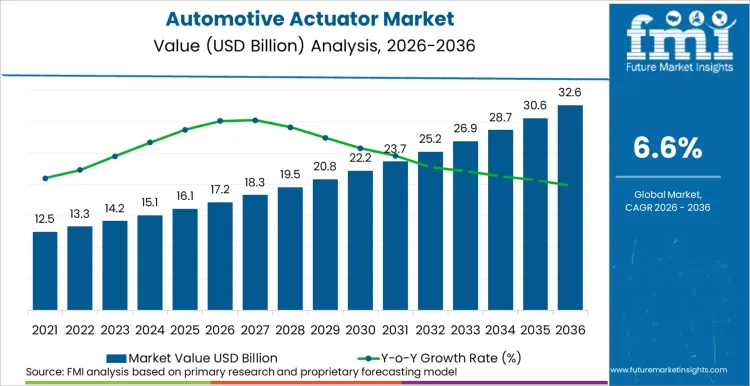
23 Feb 2026 —The Automotive Actuator Market was valued at USD 16.1 billion in 2025 and is projected to reach USD 17.2 billion in 2026, climbing steadily to USD 32.5 billion by 2036 at a CAGR of 6.6%. This sustained expansion mirrors the industry's fundamental shift toward by-wire chassis architectures, where traditional mechanical linkages are being replaced by electronic systems to enable autonomous driving capabilities and software-defined vehicles. The transition is reshaping supplier priorities, with OEMs increasingly favoring smart actuators equipped with self-diagnostics, predictive maintenance features, and low-latency performance over conventional low-cost hydraulic units.
Market snapshot: global market 2026 - 2036
Market size in 2026: USD 17.2 Billion
Market size in 2036: USD 32.5 Billion
CAGR (2026–2036): 6.6%
Leading product segment: Transmission actuators (40% market share)
Leading working type: Electric actuators (52% market share)
Leading vehicle type: Passenger cars (50% market share)
Key growth regions: Asia Pacific (led by China and India)
Top companies: Denso, Hitachi, Robert Bosch, Nidec, ZF Friedrichshafen, Magna International, Vitesco Technologies
Market Momentum (YoY Path)
The Automotive Actuator Market begins at USD 17.2 billion in 2026 and follows a consistent compound growth path at 6.6% annually. Momentum builds through the late 2020s as by-wire adoption accelerates in passenger cars and electrification deepens, pushing values higher toward the early 2030s. By 2030, the cumulative effect of rising actuator content per vehicle—especially in EVs and ADAS-equipped models—supports stronger mid-period gains, with the market reaching USD 32.5 billion by 2036 as software-defined architectures and predictive maintenance become standard across global platforms.
Why the Market is Growing
The Automotive Actuator Market is expanding due to the transition to brake-by-wire and steer-by-wire systems, which eliminate mechanical linkages and support autonomous functionality. Stringent fuel economy regulations are driving demand for precise engine, transmission, and thermal management actuators. The rapid integration of active safety features and ADAS in mass-market vehicles further boosts uptake of advanced electric actuators capable of delivering millisecond response times and integrated health monitoring.
Segment Spotlight
Product Type
Transmission actuators hold 40% of the Automotive Actuator Market value, fueled by the rise of multi-speed automatics, e-axle disconnect systems, and park-lock mechanisms in electric powertrains. Shift-by-wire adoption removes bulky mechanical linkages, enabling cleaner cabin designs, while driveline actuators in AWD EVs reduce drag to extend range—key priorities for meeting emissions targets and improving efficiency.
Working Type
Electric actuators dominate with 52% share in the Automotive Actuator Market, steadily displacing hydraulic and pneumatic types thanks to superior precision, lighter weight, and leak-free design. The shift to “dry” chassis architectures aligns with EV goals of reduced weight and no fluid maintenance. Electrification eliminates vacuum sources in traditional systems, making electric variants essential for brake blending, steering, thermal loops, and charge-port functions in modern platforms.
Vehicle Type
Passenger cars account for 50% of the Automotive Actuator Market share, driven by consumer demand for comfort, ADAS, and electrification features in sedans and SUVs. Higher actuator density in premium EVs—rising from around 20 to over 40 units per vehicle for thermal management and active systems—supports stronger volume growth compared to commercial segments, with standardization across platforms helping offset raw material cost pressures.
Drivers, Opportunities, Trends, Challenges Drivers
The primary force behind growth in the Automotive Actuator Market is the global move to software-defined vehicles, requiring intelligent actuators that support OTA updates, autonomous maneuvers, and redundancy. Electrification removes vacuum sources and mandates electric systems for braking and thermal control, while stricter emissions rules demand precise actuation across powertrain and chassis functions.
Opportunities —
Nearshoring in Mexico, in-wheel motor corner modules, and predictive maintenance services present strong potential. Suppliers can capture higher value through integrated “uptime as a service” offerings using actuator health data, while consolidated actuation units simplify EV assembly and appeal to new entrants.
Trends —
The industry is shifting toward smart actuators with embedded cybersecurity, self-diagnostics, and low-latency performance to enable software-defined ecosystems. Dry electromechanical systems are gaining traction to eliminate fluids, and partnerships with semiconductor firms are securing chip supply for next-generation modules.
Challenges —
High costs of redundant systems for safety-critical by-wire applications remain a barrier, especially in price-sensitive mass-market segments. Suppliers face pressure to balance advanced features with affordability, while legacy hydraulic players must rapidly acquire software and electronics expertise to avoid displacement.
Competitive Landscape
The Automotive Actuator Market features intense competition between established chassis specialists and agile mechatronic players. Leaders such as Robert Bosch, ZF Friedrichshafen, Denso, Hitachi, Nidec, Magna International, and Vitesco Technologies dominate through standardized by-wire interfaces, proprietary software bundling, and long-term OEM contracts. Legacy suppliers leverage scale and installed base, while specialists target niches like EV thermal management and high-speed steering. Success increasingly hinges on supply-chain resilience, localized production in friend-shoring regions, and secure access to semiconductors and rare-earth materials.
Get Access of Report Sample:https://www.futuremarketinsights.com/reports/sample/rep-gb-4699
Scope of the Report
Quantitative Units: USD billion (2026 baseline: USD 17.2 billion)
Segmentation: Product Type (Transmission Actuators, Brake Actuators, Driveline Actuators); Vehicle Type (Passenger Cars, LCV, HCV); Working Type (Electric, Hydraulic, Pneumatic); Sales Channel (OEM, Aftermarket); Region
Regions Covered: North America, Latin America, Europe, East Asia, South Asia, Oceania, Middle East & Africa
Countries Covered: United States, Canada, Mexico, Brazil, Argentina, Germany, France, United Kingdom, Italy, Spain, China, India, Japan, South Korea, Indonesia, Australia and 40+ additional countries
Explore More Related Studies Published by FMI Research:
Automotive Lighting Actuators Market: https://www.futuremarketinsights.com/reports/automotive-lighting-actuators-market
Automotive Electric Actuators Market: https://www.futuremarketinsights.com/reports/automotive-electric-actuators-market
Automotive Electric Actuator Market: https://www.futuremarketinsights.com/reports/automotive-electric-actuator-market
Automotive Turbocharger Market: https://www.futuremarketinsights.com/reports/global-automotive-turbochargers-market
About Future Market Insights (FMI)
Future Market Insights, Inc. (FMI) is an ESOMAR-certified, ISO 9001:2015 market research and consulting organization, trusted by Fortune 500 clients and global enterprises. With operations in the U.S., UK, India, and Dubai, FMI provides data-backed insights and strategic intelligence across 30+ industries and 1200 markets worldwide.
Why FMI: Decisions that Change Outcomes- https://www.futuremarketinsights.com/why-fmi
Contact Us:
Future Market Insights Inc.
Christiana Corporate, 200 Continental Drive,
Suite 401, Newark, Delaware – 19713, USA
T: +1-347-918-3531
Website: https://www.futuremarketinsights.com
Sudip Saha
Future Market Insights Inc.
+1 347-918-3531
email us here
Legal Disclaimer:
EIN Presswire provides this news content "as is" without warranty of any kind. We do not accept any responsibility or liability for the accuracy, content, images, videos, licenses, completeness, legality, or reliability of the information contained in this article. If you have any complaints or copyright issues related to this article, kindly contact the author above.
