

Global Gasoline Direct Injection Market Led by Asia-Pacific Demand with Bosch, Denso & Continental
Gasoline Direct Injection Market
Rising Emission Regulations, Turbocharged Engine Adoption, and Hybrid Integration Accelerate Long-Term Market Transformation
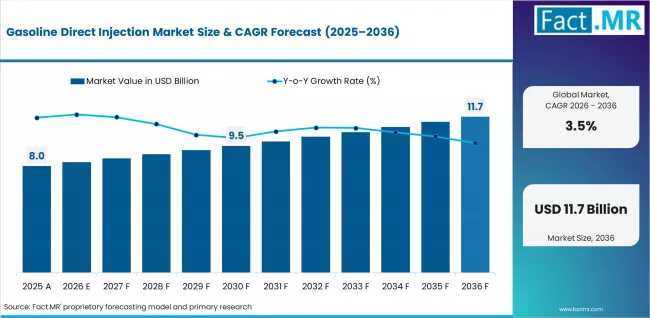
ROCKVILLE, MD, UNITED STATES, April 9, 2026 /EINPresswire.com/ -- According to Fact.MR’s latest analysis, the global gasoline direct injection (GDI) market is undergoing a structural transformation driven by efficiency-focused powertrain innovation and tightening emission norms. The market is valued at USD 8.0 billion in 2026, up from USD 7.8 billion in 2025, and is projected to reach USD 11.2 billion by 2036, expanding at a CAGR of 3.5%. The market is expected to create an incremental opportunity of USD 3.3 billion over the forecast period.This growth is not volume-driven but technology-led, as automakers increasingly integrate advanced fuel injection systems to improve combustion efficiency, enable engine downsizing, and meet stringent global emission standards.
Get detailed market forecasts, competitive benchmarking, and pricing trends: https://www.factmr.com/connectus/sample?flag=S&rep_id=14692
Quick Stats
Market Size (2026): USD 8.0 Billion
Market Size (2025): USD 7.8 Billion
Forecast Value (2036): USD 11.2 Billion
CAGR (2026–2036): 3.5%
Incremental Opportunity: USD 3.3 Billion
Leading Segment: Passenger Vehicles
Leading Region: Asia-Pacific
Key Players: Bosch, Denso Corporation, Continental AG, Delphi Technologies, Hitachi Astemo, Magneti Marelli
Executive Insight for Decision Makers
The gasoline direct injection market is shifting from component supply to integrated system solutions.
OEMs and manufacturers must prioritize early-stage collaboration, system integration, and calibration expertise to secure long-term contracts.
Investors should focus on companies developing high-pressure injection systems and hybrid-compatible technologies.
Failure to adapt to integrated, technology-driven solutions may result in margin erosion and loss of OEM partnerships.
Market Dynamics
Key Growth Drivers
Rising demand for fuel-efficient and low-emission vehicles
Increasing penetration of turbocharged and downsized engines
Stringent emission regulations across Europe, China, and India
Expansion of passenger vehicle production in emerging markets
Key Restraints
Gradual shift toward electric vehicles (EVs)
High dependency on semiconductors and precision components
Cost pressures in standardized component segments
Emerging Trends
Integration of GDI systems in hybrid powertrains
Development of high-pressure multi-hole injectors
Shift toward modular and pre-calibrated systems
Increasing focus on software-driven combustion optimization
Segment Analysis
Leading Segment: Passenger vehicles dominate with the highest share due to large-scale adoption of fuel-efficient engines.
Fastest-Growing Segment: Turbocharged engine applications, driven by performance and efficiency requirements.
Breakdown
By Component: Fuel injectors, high-pressure pumps, ECUs, sensors
By Vehicle Type: Passenger cars, commercial vehicles
By Engine Type: Naturally aspirated, turbocharged, hybrid
Strategic Importance
High-value components such as injectors and control systems are becoming central to differentiation, shifting value from volume to precision engineering and system integration.
Supply Chain Analysis (Critical Insight)
Value Chain Structure
Raw Material Suppliers: Specialty steel providers, semiconductor manufacturers, precision alloy suppliers
Component Manufacturers: GDI system producers (injectors, pumps, ECUs)
Tier-1 Suppliers / Distributors: Integrate systems and supply to OEMs
OEMs (Automakers): Integrate GDI into engines
End Users: Passenger vehicle buyers and fleet operators
Who Supplies Whom
Semiconductor and alloy suppliers → Component manufacturers
Component manufacturers → Tier-1 suppliers / OEMs
Tier-1 suppliers → Automotive OEMs
OEMs → End consumers
Key Insight
OEMs are increasingly shifting toward direct partnerships with GDI manufacturers, ensuring long-term supply security and system-level integration.
Pricing Trends
Commodity vs Premium:
Standard injectors face commoditization
Advanced high-pressure systems command premium pricing
Key Influencing Factors
Raw material costs (steel, alloys, semiconductors)
Emission compliance requirements
Technological complexity
Supply chain disruptions
Margin Insights
Integrated systems and advanced configurations deliver 8%–15% higher margins
Suppliers offering end-to-end solutions gain stronger pricing power
Regional Analysis
Top Countries by CAGR
India: 4.6%
China: 4.2%
Japan: 3.2%
Canada: 3.2%
United States: 2.8%
Regional Insights
Asia-Pacific: Dominates due to high vehicle production and regulatory push
North America & Europe: Mature markets driven by replacement demand and efficiency upgrades
Emerging Markets: Growth fueled by urbanization and rising vehicle ownership
Developed vs Emerging
Developed markets focus on technology upgrades
Emerging markets drive volume growth and new adoption
Competitive Landscape
Market Structure: Moderately consolidated with strong Tier-1 dominance
Key Players
Bosch
Denso Corporation
Continental AG
Delphi Technologies
Hitachi Astemo
Magneti Marelli
Competitive Strategies
Technology innovation (high-pressure systems)
OEM partnerships and co-development
Expansion into hybrid-compatible solutions
Integrated system offerings
Strategic Takeaways
For Manufacturers
Invest in advanced injection technologies and system integration
Move up the value chain with software and calibration capabilities
For Investors
Focus on firms with OEM partnerships and hybrid system expertise
Prioritize technology-driven differentiation
For Marketers / Distributors
Shift messaging from price to performance and efficiency benefits
Target OEM collaboration and aftermarket opportunities
Future Outlook
The GDI market is expected to evolve as a technology-driven, value-focused segment within the broader automotive ecosystem.
Hybrid vehicles will extend the lifecycle of gasoline engines
Advanced injection systems will remain critical for emission compliance
Innovation in combustion optimization and electronics will shape long-term demand
Conclusion
The global gasoline direct injection market is not declining but repositioning itself as a high-value, technology-centric segment.
As the automotive industry transitions toward electrification, GDI systems continue to play a critical role in enhancing engine efficiency, supporting hybrid platforms, and meeting emission targets.
For decision-makers, the opportunity lies in embracing integration, innovation, and strategic partnerships—ensuring sustained competitiveness in an evolving powertrain landscape.
Unlock 360° insights for strategic decision making and investment planning: https://www.factmr.com/checkout/14692
To View Our Related Report:
CNG Direct Injection Fuel Systems Market https://www.factmr.com/report/cng-direct-injection-fuel-systems-market
V2X Bidirectional EV Charger Market https://www.factmr.com/report/v2x-bidirectional-ev-charger-market
Automotive Fuel Injection Pump Market https://www.factmr.com/report/3493/automotive-fuel-injection-pump-market
Hydrogen ICE Fuel Injection Systems Market https://www.factmr.com/report/hydrogen-ice-fuel-injection-systems-market
S. N. Jha
Fact.MR
+ +1 628-251-1583
email us here
Legal Disclaimer:
EIN Presswire provides this news content "as is" without warranty of any kind. We do not accept any responsibility or liability for the accuracy, content, images, videos, licenses, completeness, legality, or reliability of the information contained in this article. If you have any complaints or copyright issues related to this article, kindly contact the author above.
